
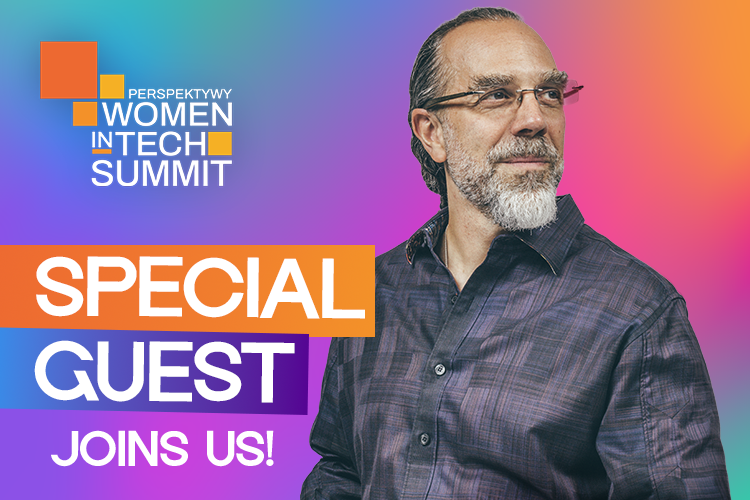
The Special Guest at this year’s Perspektywy Women in Tech Summit 2026 will be a man whose job is to create the future. And we’re not talking about just another Big Tech executive, but a man at the very heart of the world’s most ambitious technological experiments. Astro Teller - for it is he - runs one of the most extraordinary places in the tech world: a lab whose mission isn’t to improve existing products, but to systematically create things that initially sound like overly risky experiments.
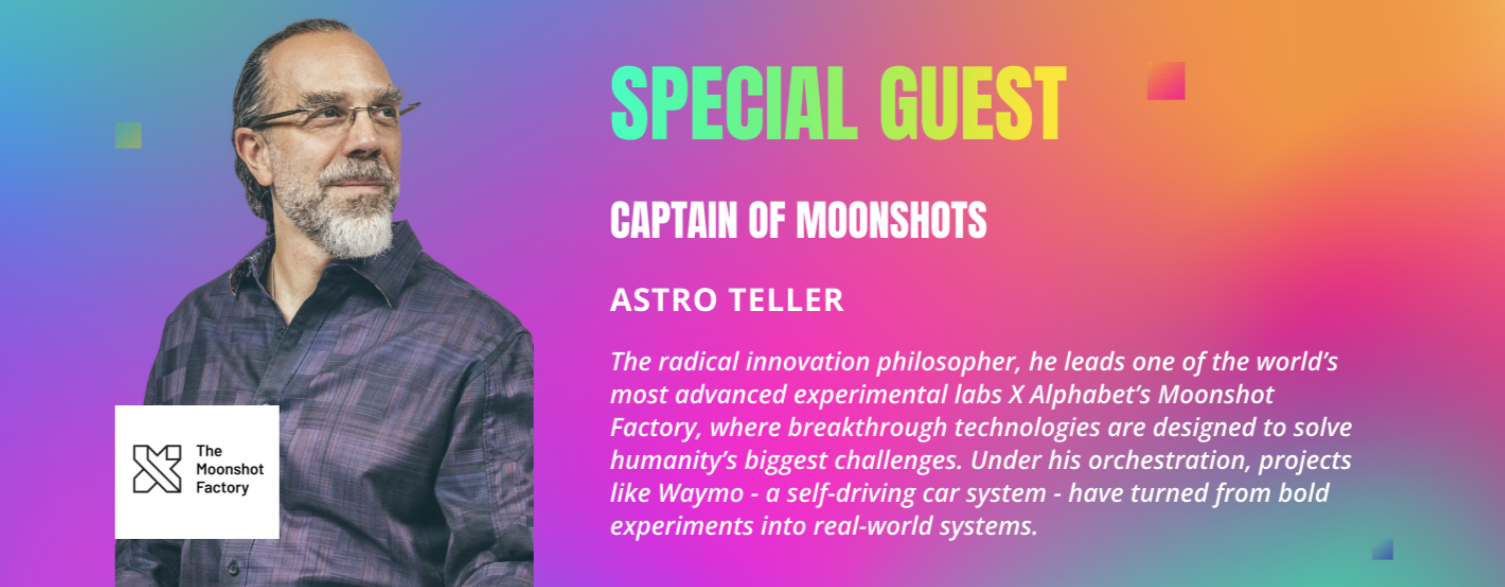
As CEO of X (formerly Google X), now known as the Moonshot Factory and owned by Alphabet, he is responsible for projects that aim to solve problems on a civilizational scale. It was there that Waymo, Wing, and Verily were born - ventures that began as internal experiments and later became independent companies. In an industry full of slogans about “changing the world,” Astro Teller belongs to a small group of people who are trying to turn that declaration into a real operating model. He doesn’t bother with cosmetic tweaks and improvements to existing systems. He’s more interested in whether they can be built from scratch: faster, cheaper, safer, and on entirely different principles.
His own biography explains this approach well. Teller earned a Bachelor of Science in Computer Science and a Master of Science in Symbolic and Heuristic Computation from Stanford University, as well as a Ph.D. in Artificial Intelligence from Carnegie Mellon University. He also comes from a family where science was a way of life: his grandfather was Edward Teller, one of the most important physicists of the 20th century, and his other grandfather was Gérard Debreu, a Nobel laureate in economics. This combination of physics, mathematics, and systems analysis is very clearly reflected later in his way of thinking about technology.
Before joining Google, he built his own companies. Among other ventures, he co-founded BodyMedia - one of the first companies to develop tools for monitoring sleep, activity, and physiological metrics, long before the era of Fitbits and Apple Watches. He also ran Cerebellum Capital, where he explored the use of machine learning in investment management. These experiences gave him something more important than startup success: a very practical understanding that even the most brilliant technology without a business model remains nothing more than a curiosity.
Most interesting, however, is Astroteller’s approach to failure. In most corporations, failure is a PR problem. At X, however, it is a working tool. Teller has been saying for years that the worst projects aren’t the ones that failed, but those that should have been shut down long ago and are still consuming time, people, and budget. That is why, by his definition, a moonshot must meet three conditions simultaneously: it must address a massive problem, propose a radical solution, and be based on technology that has a realistic chance of being developed. It’s not about a few percent improvement. It’s about a change of scale - tenfold, and sometimes a hundredfold!
Teller often says that a 10% improvement forces you to compete with everyone who is doing exactly the same thing. Attempting a 10-fold improvement requires abandoning existing assumptions and finding a new perspective. That is where true innovation begins. In practice, this means very strict rules. At X, there are so-called “kill metrics” - pre-determined parameters whose failure to meet automatically signals the end of a project. Teams are rewarded for proving that their own idea should not be further developed. Bonuses, promotions, public recognition. The goal is not to defend a project at all costs, but to arrive at the truth as quickly as possible.
The most famous example of this philosophy’s success remains Waymo. Today, most people simply associate it with self-driving taxis, but for years it was one of the world’s riskiest technological experiments. The goal was not to create a “driverless car,” but a system safer than a human - and that required a decade of testing, constant learning, and tremendous operational discipline.
Closed and abandoned projects are just as important to Teller. For example, Project Loon was intended to provide internet access to remote regions of the world using stratospheric balloons. Technologically, the project was impressive: the balloons could stay aloft for many months and precisely harness atmospheric currents. It was shut down because they failed to create a business model that was economically sustainable. This is one of X’s most important lessons: technological success isn’t enough. If a solution can’t function outside the lab, it remains an experiment.
This logic became even more pronounced after 2024, when X underwent a major structural change. Alphabet began demanding greater capital discipline and a more rigorous market test. The Series X Capital fund was established - approximately $500 million earmarked for financing projects moving out of the lab. Alphabet remained an investor, but ceased to be the sole source of funding. This is an important signal: even the most ambitious “factory of the future” must now justify its effectiveness not only technologically, but also financially. Teller views this as a natural stage of maturation. Projects develop faster when they leave the safe confines of a large corporation and begin to operate like real startups - facing market pressure, accountability for results, and the need to prove their own worth independently.
That is why Astro Teller attracts so much attention - not only as a technology leader, but as the architect of a particular way of thinking. He demonstrates that radical innovation does not have to be chaotic or a romantic cult of the visionary. It can be designed as a process: with rules, metrics, and a willingness to quickly discard bad ideas.
In a world where nearly every company claims to be building the future, his approach is exceptionally pragmatic. It relies less on tales of genius and more on intellectual discipline and the courage to make unpopular decisions. And perhaps that is precisely why X remains one of the most important laboratories of the 21st century. Not because of the size of the budget or the spectacular nature of the projects, but because of the consistency in distinguishing between what is truly feasible and what merely sounds good on a conference stage.