
When we talk about humanity’s return to the Moon, we usually picture rockets, the Orion spacecraft, mission control, and breathtaking images of Earth seen from deep space. But behind every crewed mission there is another layer - less spectacular, but absolutely critical: space medicine. It answers a question that, in the Artemis era, becomes just as important as engine performance or flight trajectory: how do we send humans farther than ever before and make sure their bodies are ready for the journey?
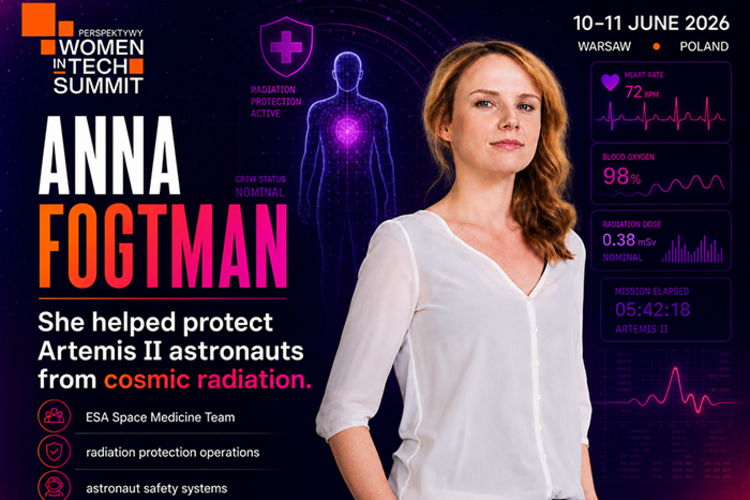
One of the people working precisely at this frontier of technology, biology, and human resilience is Dr Anna Fogtman, a Polish expert at the European Space Agency and a guest of Perspektywy Women in Tech Summit 2026. At ESA, she leads radiation protection operations at the European Astronaut Centre in Cologne, and together with her team she supported the protection of Artemis II astronauts from space radiation.
Space medicine begins where Earth’s protection ends
In low Earth orbit, astronauts are still partially protected by Earth’s magnetosphere. In lunar missions, the situation changes dramatically. Beyond this natural shield, the human body is exposed to a much harsher radiation environment: galactic cosmic rays and particles associated with solar activity.
This is exactly the area Dr Fogtman works on: risk assessment, operational procedures, and strategies to reduce radiation doses for astronauts travelling beyond low Earth orbit. Her scientific work is connected with the ESA Radiation Protection Initiative, including the review of current risk models and the identification of knowledge gaps needed to develop more advanced models for crewed missions beyond LEO.
Dr Fogtman joined ESA in 2017. Until the end of 2023, she worked as a Crew Exploration Scientist, focusing, among other areas, on medical operations planning for exploration missions. Since January 2024, she has served as Radiation Protection Operations Lead. This means moving from research and planning into a very concrete layer of mission safety: the radiation protection of astronauts.
Artemis II: a major test of technology and biology
Artemis II was the first crewed mission of the Artemis programme and the first human flight around the Moon since the Apollo era. The crew - Reid Wiseman, Victor Glover, Christina Koch, and Jeremy Hansen - travelled aboard Orion on a nearly 10-day journey around the Moon before safely returning to Earth.
For medical and operations teams, this mission carried enormous significance. Orion had to be tested with humans on board in a real deep-space environment. Artemis II was, in this sense, a major test: of systems, procedures, communication, spacecraft behaviour, and crew readiness for situations that cannot be fully recreated on Earth.
Dr Fogtman’s role was not about talking about space from a safe distance. It concerned real mission procedures: monitoring radiation risk, preparing responses to potential increases in radiation levels, and supporting the crew safety system. Outside low Earth orbit, astronauts are exposed to more high-energy galactic radiation, which matters especially for long-term health risk.
Helga, Zohar, and the data changing spaceflight safety
Before humans flew on Artemis II, the uncrewed Artemis I mission delivered data that is now crucial for planning astronaut protection. On board Orion were two phantoms - Helga and Zohar - advanced human-body models designed to measure radiation exposure. They were part of MARE, the Matroshka AstroRad Radiation Experiment, led by the German Aerospace Center, DLR, in cooperation with international partners.
Helga and Zohar had female body shapes, and their “bodies” were filled with thousands of sensors measuring the distribution of radiation dose across different organs and tissues. This was especially important because Artemis is not only about returning humans to the Moon. It is also about making lunar exploration more inclusive and more representative of the actual diversity of astronaut crews.
The female shape of the phantoms was therefore not symbolic. It was medical and operational. The Artemis programme includes women in human lunar exploration, and radiation protection must take into account how different bodies may experience and respond to radiation exposure.
The Artemis I data also showed that radiation protection is not only about shielding material. It also depends on where a person is located inside the spacecraft and how the spacecraft itself is oriented. NASA reported that during one change in Orion’s orientation, radiation levels dropped by almost half - confirming that operational procedures and spacecraft configuration can have a real impact on crew safety.
Protecting humans in deep space
Space radiation remains one of the greatest barriers to long-duration human presence beyond Earth. It cannot simply be eliminated. It has to be measured, predicted, modelled, and reduced. Scientists and mission teams need to understand how radiation affects different tissues, how risk accumulates over time, how mission duration should be planned, how shielding should be designed, and how crews should respond when solar activity becomes dangerous.
This is where the work of experts like Anna Fogtman begins. Her field connects science with operations: radiobiology with mission procedures, data with decisions, medicine with engineering. In the world of Artemis, astronaut safety depends on thousands of elements - from engines and communication systems to biological risk models. Fogtman works on one of those elements that will become increasingly important the farther humans travel from Earth.
Her presence at Perspektywy Women in Tech Summit 2026 is especially meaningful. It is a chance to meet an expert who not only represents the European space sector, but also shows that the future of space exploration will be built by interdisciplinary teams: biologists, physicians, engineers, physicists, data specialists, risk experts, operations leaders, and safety professionals.
Artemis is a story about humanity’s return to the Moon. Anna Fogtman’s work reminds us that behind this return there are not only great machines and spectacular launches, but also precise, demanding, and deeply responsible work by scientists who protect the biological frontier of exploration.
Because if we want to build a future for humans in space, we first need to understand how to protect the human body.