
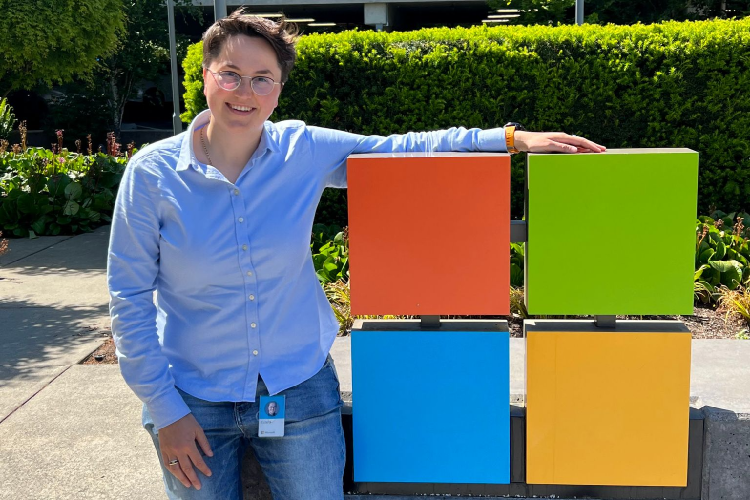
As we celebrate the 10th anniversary of the "New Technologies for Women" (NTDD) program, we are thrilled to showcase the inspiring stories of our graduates who have gone on to achieve remarkable success in their careers. Today, we are honored to speak with Estera Kot, Principal Product Manager at Microsoft and an alumna of the program's very first edition in 2015. Estera's journey is a testament to the transformative power of education and mentorship, as well as her unwavering dedication to innovation and excellence in the tech industry.
In this exclusive interview, Estera reflects on her experience as part of the inaugural cohort, shares insights from her impressive career path, and offers advice for the next generation of women breaking barriers in technology. Join us as we explore how the NTDD program played a role in shaping her career and how she continues to make a difference in the ever-evolving tech world.
Perspektywy Women in Tech: Ten years ago…
Estera Kot: I was biking to university (Warsaw University of Technology) and happened to be near Constitution Square when a friend called me. She said, “Hey, there’s this meeting about to start for a new program organized by Intel and Perspektywy. I’m worried not many people will show up. Can you come and fill the space?” I said, “Sure,” but in truth, my eyes lit up. It sounded super interesting to me: I had studied Intel during my classes, and I knew Perspektywy was behind all those important rankings.
Perspektywy Women in Tech: You remember the details very clearly. Why?
Estera Kot: Because this program helped shape my career path, transformed my mindset, and gave me courage. Plus, back when I was still a student, the "New Technologies for Women" program was something truly exceptional, a real "WOW."
Perspektywy Women in Tech: What does "WOW" mean specifically?
Estera Kot: First, it was exclusively for women. At a time when courses like mine (electrical engineering) were overwhelmingly dominated by men—often programming since they were five years old—this meant that in any other competition or program, women would often "disappear" in the male crowd and be at a disadvantage, especially since most programs only offered one or two slots nationwide. Second, to get a scholarship in NTDD, all you had to do was present your achievements so far—no need to create a specific project or do something special just for the program. Third, the scholarship amount was, at the time, unimaginable for a student’s budget. I think it’s still significant, but back when I applied, it was a staggering sum. Finally, and most importantly for me, beyond the financial support, those who got into the program were paired with mentors from what was then, for us, a legendary company.
Perspektywy Women in Tech: Did you understand at the time what role such a mentor would play?
Estera Kot: Not entirely, as there was a lot of talk about coaching back then, but mentoring for students wasn’t a clear concept. I simply imagined I’d get to connect with someone working in a company I almost mythologized, who had a similar education and interests or goals but was far ahead of me in experience and knowledge. I thought this person would speak the same language as me but would help me safely plan my next educational and career steps. And they’d give me an insider’s view of the professional world I was about to enter after university.
Perspektywy Women in Tech: Did those expectations come true?
Estera Kot: It’s no exaggeration to say that participating in this program changed my entire life. I gained confidence and the courage to pursue my dreams, achieve my goals, and boldly express who I am.
Perspektywy Women in Tech: How did this transformation happen?
Estera Kot: It was largely thanks to my mentor, Paweł Koniszewski, who focused on improving my soft skills and helping me overcome my fear of speaking up about what I know and want. He identified my challenges and helped me open up. He gave me tasks and provided honest feedback on how I performed. That was probably the most important part: I never felt criticized by my mentor. Instead, I felt like I had a guide who cared about me, and their feedback helped me take more confident steps forward. That’s why NTDD directed my career path. Even though ten years have passed since I participated in the program, and although I don’t work at Intel, I still proudly introduce myself as an NTDD alumna. The program—and the internship in the USA that I got as one of two participants from the first edition—helped me build a solid foundation to stand on and launch myself further.
Perspektywy Women in Tech: What does "further" mean for you professionally today?
Estera Kot: In general, thanks to NTDD and the subsequent internship at Intel, I developed skills in programming languages and big data technologies that continue to shape my career. Initially, I used them to write code for Open Source libraries, and today, as a product manager, I create products based on those same libraries and sell them to the world’s largest companies. The NTDD program ensured I reached a relatively high career level.
Perspektywy Women in Tech: So, in your case, NTDD was a complete success.
Estera Kot: Not just in my case, and not just 100% (laughs). I always say you can’t outdo how much I benefited from this program because I succeeded in every possible area.
Perspektywy Women in Tech: What do you mean?
Estera Kot: For example, I built a network of friendships and still keep in touch with most of the women who participated not only in the first edition but in later ones as well. Thanks to the NTDD scholarship, I went on my first-ever vacation because, until then, all my money went toward courses and education. So, the program allowed me to take care of myself and my well-being. And, last but not least: I met my significant other through NTDD. We were both in the program together. Thanks to NTDD, I found the confidence to feel good about myself.
Perspektywy Women in Tech: How would you encourage others to join NTDD?
Estera Kot: I can wholeheartedly say that this program is the best way to start building your career. Any woman interested in new technologies and willing to take responsibility for her development should take advantage of it. And don’t worry: you don’t need to have a clear career vision when applying to the program. All you need is an openness to discovering your professional preferences or being ready to adjust your career goals.