
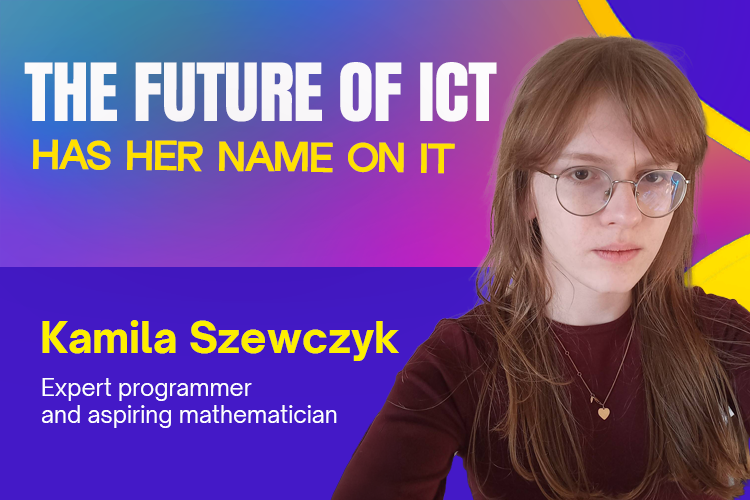
In recent days, the media has been flooded with articles about a 21-year-old Polish woman who fixed a “20-year-old bug in Linux.” The story of a single PDF file that crashed the system and a brilliant patch has made the rounds from tech to lifestyle websites. The mainstream media loves such narratives—they suggest a sudden flash of genius that puts “old hands” to shame. However, if we look at the facts, we’ll discover that the media hype focused on the least significant part of Kamila Szewczyk’s work. The problem is that reducing a young programmer to the role of “the girl who fixed the Linux bug” is like calling an outstanding surgeon “the clever guy who quickly stitched up his own hand.” To truly understand why Kamila is one of the most fascinating figures in contemporary Polish (and European) IT, we need to look much deeper than the code of the Enlightenment E16 environment.
Student, programmer, and aspiring mathematician
Let’s start with the facts that get lost in the media hype. Fixing the bug in the E16 window manager wasn’t a matter of luck. Kamila, a student at the prestigious Saarland University, has for years been working in areas of computer science that many programmers consider black magic: low-level programming, compression theory, and algorithms.
As Kamila herself admits on her blog, she wrote the post about the bug at 5:00 a.m. out of sheer frustration. She was preparing materials for her first university lecture on information theory at the time, and the bug in the window manager (which she has been using for years because she values its lightness) was simply getting in the way of her work on the slides. This bug had been known since around 2006, but remained unresolved. Not because it was particularly complex, but because it occurred rarely, required specific input data, affected a niche system component, and, above all, was not critical for most users.
Debugging Edge Cases on a Daily Basis
The bug in question affected a component of the Enlightenment E16 desktop environment, a project that has been in development since the late 1990s. It stemmed from the mechanism that adjusts the window title length to fit the available interface space. The implementation of this feature used an iterative numerical algorithm based on Newton’s method. In theory, this solution was correct, but in practice, it lacked one key element that is absolutely fundamental in production systems: a limit on the number of iterations. As a result, under certain very specific input conditions, the algorithm was unable to find a solution and entered an infinite loop. This caused the entire graphical environment to crash. Errors of this kind are not uncommon in systems developed over many years, especially when they concern low-priority functions and are difficult to reproduce unambiguously.
The solution proposed by Szewczyk did not involve changing the algorithm’s mathematical foundations or completely rewriting it. Instead, she introduced a set of safeguards that ensure stable operation regardless of the input data. A key element was limiting the number of iterations, which eliminates the risk of an infinite loop. Additionally, boundary value checks and safeguards against unauthorized operations, such as division by zero, were implemented. From a software engineering perspective, this is a model solution because it does not prioritize mathematical elegance at the expense of stability, but ensures deterministic system behavior under all conditions.
Media Hype vs. Real Achievements
The fact that the bug persisted for twenty years was not due to its particular complexity, but rather to a combination of factors typical of open-source projects. It affected a niche component, occurred only with specific input data, and was not critical for most users. In such cases, many issues remain unresolved for a long time because fixing them does not provide commensurate value to the community developing the project.
What the media called a “historic feat” was, for Kamila, a routine “cleanup” of the code: she fixed a bug in her everyday work tool, which she herself has been modifying and optimizing for years. Because real programming work isn’t flashy fireworks, but the tedious debugging of edge cases that no one else wanted to touch for two decades. It’s a discipline of the mind that allows one to notice that—in this case—the code was missing a “safety net” in the form of an iteration limit. The media narrative focused almost exclusively on this one incident because it is easy to recount and understand. At the same time, areas that much better describe Szewczyk’s actual skill set were almost completely overlooked. The programmer herself distances herself from this fame, noting with bitter irony: “I did absolutely nothing to become famous because of the window manager. It’s a shame the media doesn’t report as eagerly on my groundbreaking scientific work.”
Low-level programming, compression theory, and algorithms
If we want to discuss Kamila’s actual achievements, we must mention the projects that have a tangible impact on the global scientific community. Her own publications and materials indicate that she focuses primarily on data compression, particularly the highly demanding field of genomic data compression. Working with this type of data requires processing enormous volumes of information with complex structures while maintaining high precision and efficiency.
In her projects, Szewczyk employs a modular approach that separates different types of data and applies distinct compression models to each. She utilizes advanced techniques such as the Burrows-Wheeler transform, arithmetic coding, and Markov models. These are well-known tools in compression theory, but their effective application in practice requires a very good understanding of both the mathematical foundations and the implementation limitations. Available information indicates that her solutions achieve results that are competitive with existing methods, placing this work at the level of advanced research engineering.
Another key aspect of its work is developing its own systems and implementations, rather than relying solely on off-the-shelf tools. Her projects include, among other things, experimental compression systems and solutions designed to operate under severe hardware constraints. This type of work requires a thorough understanding of operating systems, memory management, and optimization at a very low level of abstraction. In practice, this means working not only at the code level, but also at the level of computational models and data properties. Kamila is the author of a modern successor to the iconic bzip2 tool. Her proprietary bzip3 compressor is a tool that has made its way into the official repositories of major Linux distributions, offering performance that its predecessor could only dream of. Suffice it to say that bzip3 is used at CERN to handle data from the Large Hadron Collider! It’s a shame that news like this rarely makes the headlines, because it’s “harder to click on” than the hyped-up story of a 21-year-old who conquered Linux.
Hecate: A Revolution in Digital Genomics
Together with leading bioinformaticians, Kamila is currently working on a framework for lossless compression of genomic data. In the era of personalized medicine, where DNA sequencing generates petabytes of data, optimizing its storage enables a real acceleration of research into new drugs and gene therapies. In March 2026, the research paper “Hecate: A Modular Genomic Compressor” was published, co-authored by Kamila and Prof. Sven Rahmann of Saarland University. Hecate is a Pareto-optimal solution that proves to be 2 to 10 times faster than existing global standards (such as MFCompress or NAF) while maintaining the same compression ratio. In this context, does fixing a Linux bug still seem like a groundbreaking achievement? Let’s be serious: Kamila Szewczyk is not a “talented student who got lucky,” but a seasoned programmer and talented researcher who publishes on arXiv and creates tools that modern science relies on. The true value of Kamila’s work lies in what isn’t immediately apparent: in optimizing data flow, in boldly delving into low-level system structures, and in diligent, scientific work.
Competence Has No Gender
Amid the media buzz surrounding Kamila, the cesspool of industry prejudices has resurfaced once again. Hundreds of comments appeared under articles about her success, questioning her expertise, scrutinizing her appearance, or suggesting that “it’s just a simple fix.” Unfortunately, this is a common and symptomatic phenomenon. The visibility of women in ICT still triggers a defensive reaction in many people that has nothing to do with the substance of the matter. The hate Kamila had to face shows that, as an industry, we still have a huge lesson to learn.
Because competence has no gender, and Kamila Szewczyk is not an “exception to the rule”—she represents a growing number of female engineers who perform titanic work every day behind the scenes of the systems we all use. The difference is that news sites rarely write about their work, because “tedious data compression optimization” gets fewer clicks than “Wow! She fixed Linux after 20 years!
International Day of Girls in ICT
Today, April 23, 2026, we celebrate the International Day of Girls in ICT, and Kamila Szewczyk’s story is the perfect illustration of this occasion: it shows that women in the tech industry still have to break through a wall — and this barrier isn’t just the media’s oversimplifications, which try to turn them into a novelty and a “sensation” instead of showing that they are reliable experts in their field, but also the barrier of online hate, which, instead of recognizing their achievements, focuses on a programmer’s gender, age, or appearance.
That is why on this day, we should wish for ourselves and the industry more figures like Kamila: uncompromising in their pursuit of code quality, scientifically rigorous, and resilient to the superficiality of the media. And for Kamila herself? May she continue to push the boundaries of what can be compressed and optimized. Because it is precisely these people, quietly and without the flash of cameras, who are building the foundations of our digital world.