
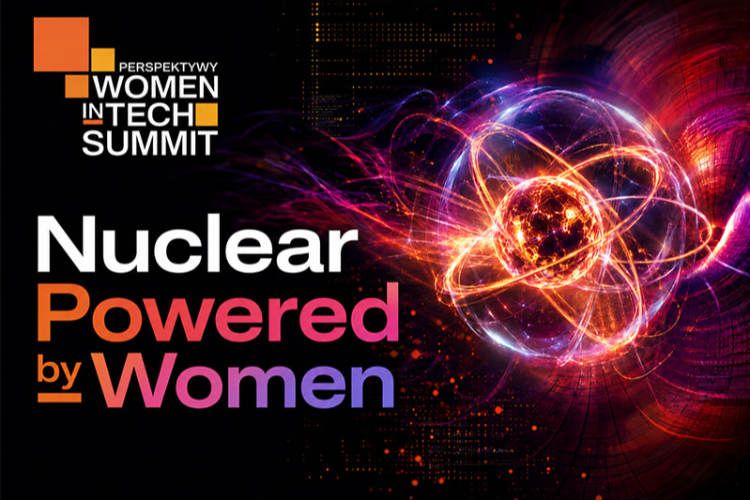
Poland is entering a new technological era and nuclear energy is becoming one of its defining forces. At Perspektywy Women in Tech Summit 2026 this transformation will have its own dedicated space: the Nuclear Zone “Nuclear. Powered by Women”, co-created with Women in Nuclear Polska.
✸Nuclear Woman Workforce Development in Poland - A.P.McAlpin (Bechtel)
✸Nuclear in Poland - From Policy to Reality - panel discussion
✸Navigating Tech Leadership While Balancing Family Life - V.Tjhang (Bechtel)
✸Women Leading Nuclear - A.Bykowska, K.Slavcheva
✸EPR, Safety at the Core: Nuclear Reactor Designed to Withstand Internal and External Hazards - A.Bedkowska (EDF)
✸Nuclear Power: Test Your Knowledge - A.Krasowska & A.Zys-Capiga (Bechtel)
✸Daily Work in Nuclear Projects - J.Kujawska (Rockfin)
✸How to Enter the Nuclear Sector: Career Paths - workshop
✸Nuclear Safety Culture: Case Study - workshop
✸CV Clinic for Future Engineers - workshop
✸Next Generation of Nuclear Professionals -— keynote speech
✸Nuclear Meets Tech - panel discussion
✸Is Nuclear Cool Again? - debate
✸From Outside to Inside: What a Nuclear Power Plant Looks Like and How It Works - S.Darewicz & G.Glemp (Bechtel)
✸My Road to Nuclear - Roksana Rosołowska (UDT)
Nuclear. Powered by Women is a space for those who want to understand energy transformation as a real technological project - and become part of it from the very beginning.
The zone will bring nuclear energy directly into the heart of Europe’s largest conference for women in tech, IT and STEM. Across two days, experts from industry, international organizations, technical supervision, engineering companies, academia and the nuclear supply chain will discuss what Poland’s nuclear future requires now: technology, safety culture, workforce development, leadership, public trust and a new generation of professionals ready to enter one of the most strategic sectors of the coming decades.
The timing is critical. Poland’s first nuclear power plant is planned in Lubiatowo-Kopalino in the Choczewo municipality, with three AP1000 units developed in cooperation with the Westinghouse–Bechtel consortium. In 2025, PEJ, Westinghouse and Bechtel signed an Engineering Development Agreement advancing the three-unit AP1000 project in Pomerania, while Bechtel has also been building partnerships with Polish technical universities to prepare future nuclear professionals.
For the Women in Tech Summit, this is more than an energy topic. It is a talent topic, a technology topic and a leadership topic. Nuclear energy needs engineers, physicists, chemists, automation experts, cybersecurity specialists, data scientists, project managers, safety professionals, lawyers, inspectors, communicators and leaders who understand how to work in high-responsibility environments. The Nuclear Zone will show where these paths begin - and why women must be visible in them from the start.
Women in Nuclear Polska: a community building knowledge, visibility and leadership
Women in Nuclear Polska is the Polish chapter of the global Women in Nuclear network. WiN Global has supported women working in nuclear energy, radiation protection, nuclear medicine and radiation-related technologies since 1993. WiN Polska belongs to WiN Europe and co-creates a global community of more than 35,000 women across 143 countries.
In Poland, WiN brings together experts, students and leaders working across nuclear energy, STEM, education, industry and public engagement. Its values are clearly defined: supporting girls and women in STEM, promoting knowledge, mentoring and inspiring leadership, and developing the nuclear future.
The current WiN Polska leadership reflects the interdisciplinary nature of the sector. Emilia Janisz, President of WiN Polska, is a long-time advocate for the nuclear sector in Brussels and Central and Eastern Europe and the initiator of the atoMY platform. Patrycja Nowakowska is an attorney and expert in nuclear energy law, advising energy-sector entities and researching civil liability for nuclear damage. Monika Silva, Deputy General Director of IGEOS Nuclear, has been connected with the energy sector for more than two decades and works on preparing Polish industry to meet the strict standards of the nuclear sector. Katarzyna Kalend combines experience from the National Centre for Nuclear Research with practical work on SMR fleet implementation. Agnieszka Świniarska-Chabros, Senior PMO Manager at Amentum, manages PMO and Project Controls teams in large energy projects.
At the Summit, WiN Polska brings this ecosystem into one space: women already working in nuclear, women entering the sector, students looking for their first role, companies searching for talent and institutions responsible for building Poland’s nuclear competence base.
Day 1: Strategy, Technology, Future
The first day of the Nuclear Zone opens with the strategic question behind Poland’s energy transformation: how nuclear power will move from policy to implementation — and how women will participate in that process.
The opening keynote block, “Polska transformacja energetyczna - rola atomu i kobiet w jej realizacji,” will set the context for the entire zone. One of the keynote speakers will be Angela P. McAlpin from Bechtel, presenting “Nuclear Woman Workforce Development in Poland.” Bechtel is one of the key companies involved in Poland’s first nuclear power plant project and has more than 70 years of nuclear experience globally. The company has also launched nuclear education and career-development cooperation with Polish technical universities, including Gdańsk University of Technology and Warsaw University of Technology.
This opening will connect two realities: Poland’s need for stable, low-emission energy and the urgent need to develop a qualified nuclear workforce. Nuclear workforce development means preparing people for long project cycles, strict safety standards, advanced engineering, international cooperation and a culture in which every decision is connected with responsibility.
The first panel, “Nuclear in Poland - From Policy to Reality,” will take the discussion from national strategy to practical implementation. Speakers will address how Poland’s nuclear programme is becoming a real industrial, technological and regulatory project: from permits and infrastructure to supply chains, competencies, knowledge transfer and execution. It will also show why the nuclear sector cannot be built only through large contracts and institutional decisions. It requires people who can work across engineering, law, safety, finance, communication and project management.
A dedicated technological keynote by Bechtel will follow. Vivi Tjhang, connected with Bechtel’s civil and structural engineering work, will speak on “Navigating Tech Leadership While Balancing Family Life.” Her session will bring a leadership perspective into a sector where technical excellence, high responsibility and long-term project work meet personal resilience, family life and career decisions. Public materials connected with Vivi Tjhang point to her role as a Civil & Structural Engineering Group Supervisor and her activity around Bechtel’s AP1000 nuclear work in Poland.
The panel “Women Leading Nuclear” will bring forward the stories of women already building their careers inside the nuclear ecosystem. Among them will be Anna Bykowska, active in Women in Nuclear Polska and connected with the industrial side of the sector, and Katya Slavcheva, a nuclear expert associated with the International Atomic Energy Agency. Katya Slavcheva is publicly listed as Technical Lead AWCRs at the IAEA and has also spoken about nuclear communication and leadership in her TEDx talk “Nuclear is cool!”
This panel will show nuclear leadership through different routes: international institutions, industry, technology, policy, supply chains and project delivery. It will also make visible a fact often overlooked in public conversations about energy: women are already present in the nuclear sector as experts, engineers, lawyers, managers, researchers and communicators. The next challenge is scale, visibility and access.
The first day will also include a block of short, concrete Lightning Talks.
Agnieszka Bedkowska from EDF will present “EPR, Safety at the Core – Nuclear Reactor Designed to Withstand Internal and External Hazards.” Her recent public activity includes knowledge-sharing around EDF’s experience and know-how in the design, construction and engineering of new nuclear projects.
Aleksandra Krasowska and Agata Zys-Capiga from Bechtel will lead an interactive presentation, “Nuclear Power: Test Your Knowledge.” The format will help participants confront assumptions, check what they already know about nuclear power and engage with the topic in a more accessible way.
Joanna Kujawska from Rockfin will speak about “Codzienna praca w projektach nuklearnych.” Rockfin positions itself as a provider of solutions for nuclear energy, including auxiliary equipment for turbine islands and nuclear islands, and works in areas relevant to both large nuclear power plants and SMR projects.
After the talks, the zone will move into practical career formats: workshops on entering the nuclear sector, nuclear safety culture and CV preparation for future engineers. These sessions will translate the nuclear programme into individual career decisions: what skills to build, how to prepare for the sector, how to understand nuclear safety culture and how to position one’s technical experience for future roles.
The first day will also include a planned panel connected with the British Embassy, bringing an international perspective into the discussion about nuclear energy, industry readiness and the development of talent pipelines.
Day 2: Talent, Innovation, Society
The second day of the Nuclear Zone will focus on the people and technologies that will shape the next phase of nuclear development.
The opening keynote, “Next Generation of Nuclear Professionals,” will address STEM competences, the role of universities and cooperation between industry and academia. This theme is already visible in the Polish market: Bechtel has signed agreements with Polish universities to support nuclear energy career-development programmes and prepare students and graduates for future work in nuclear power and related engineering fields.
The next generation of nuclear professionals will come from many disciplines. Nuclear energy needs people from energy engineering, mechanical engineering, civil engineering, electrical engineering, automation, robotics, chemistry, physics, IT, cybersecurity, data science, materials science, welding, quality control, law, project management and communication. The Summit will show how these disciplines connect inside one of the most demanding technological systems in the world.
The panel “Nuclear Meets Tech” will connect nuclear energy with the core language of the Women in Tech Summit: AI, cybersecurity, data science, automation and robotics. A nuclear power plant is a highly complex technological infrastructure: it contains control systems, operational data, sensors, cybersecurity requirements, safety procedures, inspection processes, digital tools and advanced engineering workflows. This panel will show how the nuclear sector intersects with the technologies already transforming industry, infrastructure and energy systems.
The debate “Is Nuclear Cool Again?” will bring nuclear communication into the spotlight. It will address social media, public trust, misinformation, ESG and the language used to talk about risk, safety and climate responsibility. Nuclear energy is returning to public debate at the same time as AI, electrification, data centres and industrial transformation increase the demand for reliable low-emission power. The debate will create space for a more direct conversation about why nuclear is gaining new visibility - and how to talk about it responsibly.
The second day will close with another block of Lightning Talks.
Sylwia Darewicz and Gabriela Glemp from Bechtel will present “From outside to inside: what a nuclear power plant looks like and how it works.” Their session will help participants understand the basic logic of a nuclear power plant: what can be seen from the outside, what happens inside, how the main systems are organized and why nuclear infrastructure requires such a high level of coordination and safety discipline.
Roksana Rosołowska from UDT will share “Moja droga do atomu.” Roksana Rosołowska is Head of the Laboratory Testing Department at UDT’s Gliwice office, connected with technical inspection, laboratory testing and engineering practice. UDT has publicly presented her as an engineer with a background in welding, a graduate of nuclear energy studies at Wrocław University of Science and Technology, and one of the authors involved in UDT’s nuclear-focused expert materials. In 2026, she also appeared in UDT’s conference programme with the topic “Wysokie wymagania – wysoka odpowiedzialność: badania nieniszczące w energetyce jądrowej.”
Her story brings a crucial perspective to the Summit: nuclear careers are not limited to reactor physics. They also grow out of laboratory work, welding, materials, non-destructive testing, inspection, standards and technical responsibility.
A zone for knowledge, careers and visibility
The Nuclear Zone “Nuclear. Powered by Women” will be a meeting point for people who already work in the sector and those who are just discovering that nuclear may become their future career path. It will combine strategic debate with technical knowledge, leadership stories with practical workshops, and public communication with career development.
For students, it will be a map of possible routes into the sector.
For young professionals, it will be a chance to understand where their skills fit.
For companies and institutions, it will be a place to meet the talent needed for Poland’s nuclear future.
For women already working in nuclear, it will be a platform for visibility, expertise and leadership.
At Perspektywy Women in Tech Summit 2026, nuclear energy will appear exactly where it belongs: among the technologies, industries and ideas that will define the next decades.
Nuclear. Powered by Women is a space for those who want to understand the energy transformation not as a slogan, but as a real technological project - built by people, strengthened by knowledge and opened to a new generation of women in STEM.