
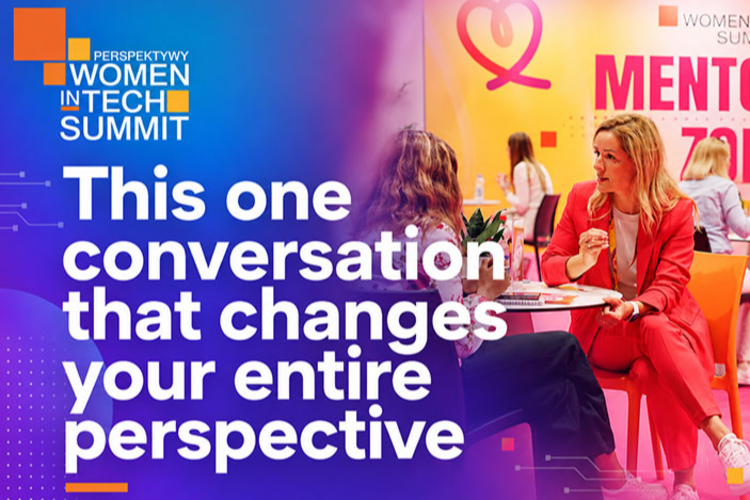
Mentoring is often described as support. In STEM, it is much more than that. It is infrastructure. It is one of the mechanisms through which people enter science, technology and engineering, understand how these worlds really work, build confidence, learn the unwritten rules of professional growth and begin to see themselves as legitimate participants in fields where they may still be underrepresented.
The data is clear. According to UNESCO, women represent only 35% of STEM graduates globally. In the European Union, women made up just 19.5% of ICT specialists in 2024. In Poland, the latest Kobiety na politechnikach 2026 report by Perspektywy and OPI PIB shows that women account for 32.4% of students at public technical universities, while on new-technology programmes at public technical universities their share is only 15.4%. These numbers are not abstract. They shape classrooms, laboratories, engineering teams, AI units, cybersecurity departments, product teams and leadership pipelines.
This is why mentoring at the Perspektywy Women in Tech Summit is not an additional attraction somewhere beside the main programme. It is one of the Summit’s most important tools for real change.
The Perspektywy Women in Tech Summit 2026 will bring together thousands of participants in Warsaw on 10–11 June 2026, with stages, workshops, Career Expo, tech talks, networking and the Mentoring Zone as part of the full Summit experience. The 2026 programme is communicated with 500 individual mentoring sessions — 500 direct, personal, one-to-one opportunities to meet people who have already crossed the thresholds many participants are now approaching.
The role of mentoring in STEM has been studied extensively. The National Academies report The Science of Effective Mentorship in STEMM states that effective mentorship has a positive effect on academic achievement, retention, degree attainment, career success, career satisfaction and career commitment. It also emphasizes that strong mentoring relationships help students and early-career professionals develop STEMM identity and a sense of belonging — two factors that are especially important for people from underrepresented groups.
That is exactly where the Mentoring Zone matters. A young woman entering STEM does not only need a lecture about career possibilities. She needs a conversation in which someone can help her connect ambition with action. Which path makes sense? Which skill should she build next? How does she prepare for her first technical interview? How does she move from university to industry? How does she talk about her competence without minimizing it? How does she survive being the only woman in the room without turning isolation into self-doubt?
These questions rarely appear in official curricula. But they decide careers.
Mentoring develops hard skills because it helps mentees understand what technical competence looks like in practice: which programming languages matter in a given field, how AI and data skills are evaluated, what companies expect from junior engineers, how research experience can translate into industry, how to approach technical projects, portfolios, internships, product work, engineering workflows or doctoral paths. But mentoring also develops the skills that often remain invisible until they become decisive: communication, leadership, self-advocacy, decision-making, feedback literacy, teamwork, negotiation, strategic career planning and resilience.
In other words, mentoring connects knowledge with agency.
For women in STEM, this connection is critical because underrepresentation is not only a statistical problem. It changes how people experience ambition. When women are a minority in a field, they often have less access to informal knowledge, fewer visible examples of senior women in technical roles and fewer opportunities to test their own plans against someone who understands both the system and the pressure. A mentoring conversation can make the hidden map visible.
Role models are a major part of that process. Microsoft’s European research found that girls’ interest in STEM almost doubles when they have role models: 41% of girls with role models report interest in STEM subjects, compared with 26% of girls without one. The same research found that girls with role models are also more likely to imagine themselves working in STEM.
This is the power of seeing someone who has already done it. A woman who leads a research team. A woman who builds software. A woman who manages infrastructure. A woman who works in AI, cybersecurity, data, cloud, quantum, nuclear energy, robotics, biotech or engineering. A woman who has changed roles, negotiated, failed, returned, learned, led, rebuilt and kept going. Role models do not make a difficult path easy. They make it thinkable.
The Perspektywy ecosystem has been built around this logic for years. IT for SHE, one of the flagship Perspektywy Women in Tech programmes, supports talented women studying IT and new technologies in entering the labour market through mentoring, Women in Tech Camp, volunteering and cooperation with leading technology companies. The programme explicitly combines career entry, technical development, management knowledge and work with mentors from companies such as Accenture, Aptiv, Citi, Ericsson, Goldman Sachs, Intel, Motorola, NatWest, P&G, Point72 and State Street.
The Summit Mentoring Zone brings this long-term philosophy into an intense, high-impact format. It compresses access, experience and guidance into one of the most practical spaces at the event. It gives participants what they cannot get from a keynote alone: individual attention. A question answered directly. A doubt treated seriously. A career idea challenged. A next step clarified.
This is why one conversation can change an entire perspective.
Because sometimes the problem is not lack of ambition. It is lack of orientation. Sometimes a young woman does not need another motivational slogan. She needs someone to tell her: this skill is valuable; this fear is common; this path exists; this company works like that; this role is closer than you think; this is how you prepare; this is where you start; this is what I wish someone had told me earlier.
That kind of conversation can change how a person reads her own future.
At the Perspektywy Women in Tech Summit 2026, the Mentoring Zone is where large-scale change becomes personal. The Summit gathers stages, experts, companies, technologies and global debates. But mentoring turns all of that into something individual and actionable: a plan, a contact, a decision, a moment of recognition, a new level of confidence.
For students and young professionals in STEM, this can be the difference between watching the future from the outside and beginning to build their place inside it.