
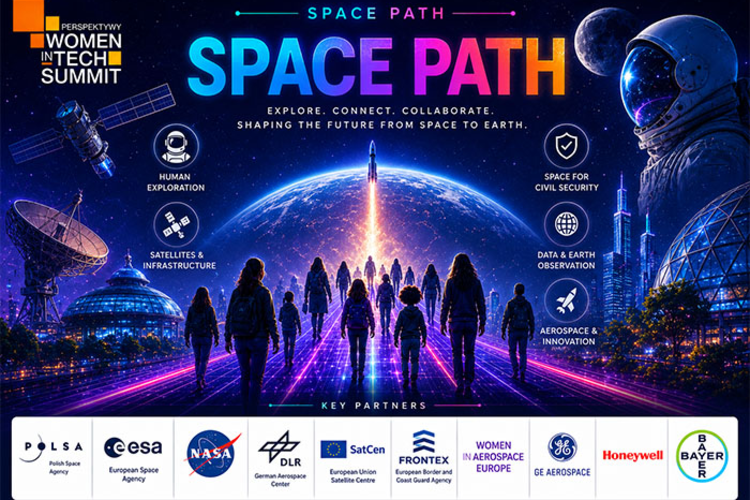
At Perspektywy Women in Tech Summit 2026, space is far more than a distant dream. It is infrastructure, security, science, medicine, engineering, data, diplomacy, aviation, agriculture and one of the most strategic technology sectors shaping the future of Europe and the world.
The Summit’s space-related programme creates a powerful route across Main Stage, Tech Stage 2, Sci/Eng Stage, Engineering Hall and workshop rooms. It brings together leading institutions and organisations such as POLSA – Polish Space Agency, ESA, SatCen, Frontex, Women in Aerospace Europe, NASA, German Aerospace Center / DLR, GE Aerospace, Honeywell, Bayer, AGH University of Science and Technology, LunAres, Polish Astrobiology Society and AstroYouth.
This path will take participants from Moon missions and astronaut safety to satellite infrastructure, space-based civil security, orbital resilience, re-entry risks, space cybersecurity, technology harmonisation, precision agriculture from space, aircraft engines, drones, connectivity and the future of aerospace engineering.
Among the key voices shaping this route are Marta Wachowicz, President of the Polish Space Agency; Anna Fogtman, Radiation Protection Operations Lead at ESA; Aleksandra Rutczyńska, Senior Software Engineer, Artemis Mission, German Aerospace Center; Ruth D. Jones, retired NASA physicist; Otylia Trzaskalska-Nuebel from ESA; Gema Maza from SatCen; Justyna Redelkiewicz from Women in Aerospace Europe; Marta Krywanis from Frontex; Angelika Gremska from Bayer; Virginia Shepardson-Serna and Anna Szewczyk from Honeywell; as well as GE Aerospace engineers and experts from POLSA’s space safety, cybersecurity, research, development, Earth monitoring, navigation and communications teams.
This is the Summit’s route for everyone who wants to understand what space really means today: a strategic domain where science meets resilience, where satellites protect societies, where data becomes critical infrastructure, where women lead high-stakes missions, and where future STEM careers are already being built.
10 June, Wednesday
09:35–10:15 | Sci/Eng Stage
Where Can Humans Go Next? Testing the Limits of Human Endurance in Extreme Environments
Format: Discussion Panel
Speakers: Aleksandra Rutczyńska, Senior Software Engineer, Artemis Mission, German Aerospace Center; Agata Harasymczak, Assistant Professor at Faculty of Space Technologies, AGH University of Science and Technology; Agata Mintus, Chief Operations Officer and Science Lead, LunAres; Izabela Świca, Member of the Board, Polish Astrobiology Society
Moderator: Weronika Boguś, Co-founder, AstroYouth
Agenda link: https://womenintechsummit.pl/agenda/event/where-can-humans-go-next-testing-the-limits-of-human-endurance-in-extreme-environments
The SPACE PATH begins with one of the most fundamental questions in human exploration: how far can the human body go? This panel explores physiology, extreme environments and emerging space-biotech thinking, looking at how the brain and body respond to isolation, pressure, radiation, oxygen deprivation and other conditions that define both deep spaceflight and the most extreme environments on Earth.
This is a must-see session for anyone interested in astronautics, human spaceflight, astrobiology, analogue missions, space medicine, extreme environment research and the future of human exploration.
10:25–10:50 | Sci/Eng Stage
Future of Flight – Next Engineers
Format: Science & Engineering session
Speakers: Anna Fornalczyk, Systems Subsection Manager, GE Aerospace; Agata Wiśniewska, Staff Engineer, GE Aerospace
Agenda link: https://womenintechsummit.pl/agenda/event/future-of-flight-next-engineers
GE Aerospace presents the Next Engineers programme and its impact on the next generation of students. The session highlights how the programme strengthens the connection between schools and business, supports technical education and helps build a future talent pipeline for engineering and aviation.
The session also connects education with the future of flight, including next-generation engine applications such as Open Fan architecture, hybrid-electric propulsion and 100% Sustainable Aviation Fuels. It is an important part of the broader aerospace route at the Summit, especially for students, educators and young people considering engineering careers.
11:00–11:20 | Engineering Hall
How Does Engine Work
Format: Special Event
Speakers: Krzysztof Dominiak, Senior Engineer CTH, Repair Engineering, GE Aerospace; Jakub Kulecki, Principal Engineer, GE Aerospace
Agenda link: https://womenintechsummit.pl/agenda/event/how-does-engine-work-1
This hands-on aerospace session takes participants inside a turbofan engine using a real cross-cut CFM56-7B aircraft engine, used on Boeing 737 aircraft. Participants will learn how turbofan engines operate, what their key components are and how they generate the power needed to lift an aircraft.
This is one of the most tangible engineering experiences on the SPACE PATH: real hardware, real aviation technology and direct contact with aerospace engineers. Group size is limited, so participants should sign up in advance at the GE Aerospace stand in the Engineering Hall.
12:45–13:00 | Main Stage
Designing Aircraft Engines with Energy in Mind
Format: Keynote
Speaker: Virginia Shepardson-Serna, Vice President, Aerospace Integration Leader, Honeywell
Agenda link: https://womenintechsummit.pl/agenda/event/designing-aircraft-engines-with-energy-in-mind
This Main Stage keynote connects aerospace engineering with energy, product design, deep tech and innovation. It brings the perspective of Honeywell’s Aerospace Integration leadership into the Summit’s broader discussion about new technologies and the future of mobility.
It is a strong aerospace moment in the programme, especially for participants interested in aircraft systems, engineering leadership, product design and the future of energy-conscious aerospace technologies.
13:05–13:45 | Tech Stage 2
Space for Civil Security
Format: Discussion Panel
Speakers: Katarzyna Dobisz, Investment Officer; Gema Maza, Deputy Head of Operations, SatCen; Justyna Redelkiewicz, Head of Entrepreneurship, Women in Aerospace Europe; Otylia Trzaskalska-Nuebel, Senior Advisor in DG Cabinet, ESA
Moderator: Marta Krywanis, Senior Research Officer, Frontex
Partners: Frontex, ESA, SatCen, Women in Aerospace Europe
Agenda link: https://womenintechsummit.pl/agenda/event/space-for-civil-security
This is one of the strongest institutional events on the SPACE PATH. The panel explores how European agencies operationalise space-based tools for security and resilience, and how innovation, financing mechanisms and operational needs can be translated into real-world solutions.
The session demonstrates Europe’s strategic leadership in space-enabled civil security and shows how space technologies support resilience, monitoring, response and safety. It also highlights the central role of women in one of the most mission-driven sectors shaping Europe’s future.
15:20–15:30 | Main Stage
ARTEMIS II Speaker – Aleksandra Rutczyńska: Moon Joy
Format: Keynote
Speaker: Aleksandra Rutczyńska, Senior Software Engineer, Artemis Mission, German Aerospace Center
Agenda link: https://womenintechsummit.pl/agenda/event/artemis-ii-speaker-aleksandra-rutczynska-moon-joy
Aleksandra Rutczyńska takes participants on a voyage to the Moon and back through Artemis I and Artemis II. Her talk connects lunar exploration, radiation detectors inside the Orion capsule, human spaceflight and the underrepresentation of women in scientific and technological data.
This is one of the most emotionally powerful and symbolically important events of the SPACE PATH. It is about the Moon, Artemis, exploration, hostile environments, data gaps and the need to send women into every science lab and every room that matters.
15:25–15:35 | Tech Stage 2
SPACE ’26 – The Reinvention of Space: Power, Pressure, and Possibility
Format: Tech Talk
Speaker: Marta Wachowicz, President of the Polish Space Agency, POLSA
Agenda link: https://womenintechsummit.pl/agenda/event/space-26-the-reinvention-of-space-power-pressure-and-possibility
This talk opens the POLSA SPACE ’26 block and frames the space sector as a domain of power, pressure and possibility. It is the strategic entry point into the Polish Space Agency’s Summit programme.
The session is essential for understanding how space is changing: from government-led exploration to a much broader ecosystem shaped by commercial actors, infrastructure needs, security, regulation, competition and technological acceleration.
15:35–15:45 | Main Stage
ARTEMIS II Speaker – Anna Fogtman
Format: Keynote
Speaker: Anna Fogtman, Radiation Protection Operations Lead, ESA
Agenda link: https://womenintechsummit.pl/agenda/event/artemis-ii-speaker-anna-fogtman
Anna Fogtman leads medical operations for radiation protection at the European Space Agency, helping keep astronauts safe on the International Space Station and preparing for future missions to the Moon and beyond.
Her work sits at the intersection of space medicine, radiation science, engineering and human exploration, covering crew dosimetry, shielding, astronaut training, operational tools and international radiation protection standards. This is one of the most important human spaceflight sessions at the Summit and a key event for anyone interested in astronaut safety, ESA, Moon missions and the future of space health.
15:40–15:50 | Tech Stage 2
SPACE ’26 – Cybersecurity Policies for Satellite Infrastructure
Format: Tech Talk
Speaker: Monika Stachoń, Security and Strategy Expert, POLSA
Agenda link: https://womenintechsummit.pl/agenda/event/space-26-cybersecurity-policies-for-satellite-infrastructure
This POLSA session focuses on the rules, standards and procedures that protect satellites, ground stations and communication links from cyber threats. It covers secure system design, encryption of data transmissions, access control, supply chain security and incident response.
The talk shows why satellite cybersecurity is now central to the integrity, availability and resilience of space-based services that modern societies and national security depend on.
16:10–16:20 | Tech Stage 2
SPACE ’26 – Orbiting Resilience: How space-based services keep society safely connected and moving
Format: Tech Talk
Speaker: Ewelina Kaatz-Drzeżdżon, Expert, Department of Earth Monitoring, Navigation and Communications, POLSA
Agenda link: https://womenintechsummit.pl/agenda/event/space-26-orbiting-resilience-how-space-based-services-keep-society-safely-connected-and-moving
This talk explains how satellites ensure continuity and stability of critical services during crises, conflicts and natural disasters. Space-based systems support resilient communication, navigation, weather monitoring and emergency response when terrestrial infrastructure is disrupted.
It is a strong example of the practical importance of space: satellites help keep societies connected, protected and operational when resilience matters most.
16:25–16:35 | Tech Stage 2
SPACE ’26 – Space safety: Does it hurt to fall from heaven? Analysis of Re-entry events
Format: Tech Talk
Speaker: Kinga Lipińska, Specialist, Department of Space Safety, POLSA
Agenda link: https://womenintechsummit.pl/agenda/event/space-26-space-safety-does-it-hurt-to-fall-from-heaven-analysis-of-re-entry-events
This session addresses space safety and the risks connected with re-entry events. It is a practical look at what happens when objects return from orbit and how space safety experts analyse and manage these risks.
The talk gives participants a clear view of space as an operational environment that must be monitored, protected and managed with precision.
16:40–16:50 | Tech Stage 2
SPACE ’26 – Why Space Rejects Cheap Solutions
Format: Tech Talk
Speaker: Adrianna Bocheńska, Chief Specialist, Department of Research and Development, POLSA
Agenda link: https://womenintechsummit.pl/agenda/event/space-26-why-space-rejects-cheap-solutions
On Earth, technology can fail, be repaired, reset or redesigned. In space, failure can be permanent. This talk explains why technologies that work perfectly on Earth cannot simply be sent into orbit and why radiation, extreme temperatures, vibration and vacuum force engineers to design and test systems in a completely different way.
It is one of the most engineering-focused talks in the POLSA block and a very clear explanation of why space technology is expensive, rigorous and exceptionally reliable.
16:55–17:05 | Tech Stage 2
SPACE ’26 – From Competition to Cooperation: How Space Exploration Teaches Us a New Diplomacy
Format: Tech Talk
Speaker: Kamila Lis, Chief Specialist, Department of Earth Monitoring, Navigation and Communications, POLSA
Agenda link: https://womenintechsummit.pl/agenda/event/space-26-from-competition-to-cooperation-how-space-exploration-teaches-us-a-new-diplomacy
From the space race to today’s global programmes, space exploration demands partnership beyond political divisions. This session looks at how missions such as the International Space Station and Artemis teach diplomacy, trust and cooperation beyond Earth.
It is the most geopolitical and humanistic talk within the POLSA SPACE ’26 block, showing space as a domain where common goals can create new forms of international collaboration.
17:10–17:20 | Tech Stage 2
SPACE ’26 – Align Early Beats Redesign Late: Space Technology Harmonisation
Format: Tech Talk
Speaker: Ida Matysek, Senior Specialist, Department of Research and Development, POLSA
Agenda link: https://womenintechsummit.pl/agenda/event/space-26-align-early-beats-redesign-late-space-technology-harmonisation
This session focuses on technology harmonisation: shared roadmaps, strategic vision and standards that help founders and researchers align early, avoid dead ends, qualify faster and build interoperable products and supply chains that scale across borders.
It is especially relevant for researchers, startups, founders, engineers and innovators who want to understand how isolated prototypes can become mission-ready capabilities for the European space ecosystem.
11 June, Thursday
09:35–10:00 | Tech Stage 2
What It Takes to Manage Agriculture from Space
Format: Tech Talk
Speaker: Angelika Gremska, Staff Data Steward, Bayer
Agenda link: https://womenintechsummit.pl/agenda/event/what-it-takes-to-manage-agriculture-from-space
This talk shows what happens after satellite imagery is captured. It follows the journey from raw data to decision-ready products and explains why access management, ordering systems, quality filtering, metadata and pipelines determine whether satellite data becomes useful.
At global scale, the key challenge is making data discoverable, trustworthy and reusable across teams, regions and use cases. This session is a practical behind-the-scenes look at how satellite data is operationalised in precision agriculture.
11:00–11:20 | Engineering Hall
How Does Engine Work
Format: Special Event
Speakers: Krzysztof Dominiak, Senior Engineer CTH, Repair Engineering, GE Aerospace; Jakub Kulecki, Principal Engineer, GE Aerospace
Agenda link: https://womenintechsummit.pl/agenda/event/how-does-engine-work-3
The second edition of the GE Aerospace engine session gives participants another opportunity to explore a real cross-cut CFM56-7B turbofan aircraft engine used on Boeing 737 aircraft.
Participants will learn how the engine works, what its key components are and how aviation engineering is applied in practice. The group size is limited, so advance registration at the GE Aerospace stand in the Engineering Hall is recommended.
12:20–13:30 | Room C4
Sky is not the limit: Drones workshop
Format: Workshop
Speakers: Karolina Makuch, Software Engineer, Honeywell; Marta Murat, Advanced System Engineer, Honeywell; Michał Słomiany, Software Engineer, Honeywell; Karolina Woźniak, Systems Engineer, Honeywell
Agenda link: https://womenintechsummit.pl/agenda/event/sky-is-not-the-limit-drones-workshop
This hands-on Honeywell workshop brings participants into the future of aviation through drones. No prior programming experience is required. The workshop combines aerodynamics, Python and systems thinking, helping participants understand the physics of flight, how drones are controlled and how autonomous missions can be designed.
It is a strong aerospace-adjacent session for beginners, tech enthusiasts, students and anyone interested in the intersection of flight, code and systems engineering.
12:25–12:40 | Main Stage
Special Guest – Ruth D. Jones: I Belong
Format: Keynote
Speaker: Ruth D. Jones, CEO, It’s All About MEI, LLC and retired physicist, NASA
Agenda link: https://womenintechsummit.pl/agenda/event/special-guest-ruth-d-jones-i-belong
Dr Ruth D. Jones brings 30 years of NASA experience to the Main Stage. Her background includes leadership, engineering, programme and project management, mishap investigation, audits, safety and mission assurance.
This keynote is a major NASA moment at the Summit. It connects aerospace leadership, mission responsibility, safety culture and belonging in STEM, bringing a deeply human perspective to high-stakes science and engineering.
14:00–14:25 | Tech Stage 1
The Power of Connectivity
Format: Tech Talk
Speaker: Anna Szewczyk, Director Engineering, Honeywell
Agenda link: https://womenintechsummit.pl/agenda/event/the-power-of-connectivity
In aviation and aerospace, connectivity is becoming the foundation of safer, smarter and more sustainable flight. This talk explores secure data exchange across aircraft, space systems, ground operations and passengers, showing how avionics, maintenance, air traffic management and space technologies are becoming part of one connected ecosystem.
The session covers predictive maintenance, optimised flight paths, connected cockpits, autonomous systems, cybersecurity, collaboration and systems engineering. It is a strong closing point for the broader SPACE / AEROSPACE PATH, linking flight, data and future mobility.
Recommended route for participants
For those who want the full SPACE PATH experience, the strongest route is:
Day 1:
Start with human endurance and space-biotech on the Sci/Eng Stage, move into GE Aerospace’s future-of-flight and engine sessions, follow the Main Stage aerospace keynote, attend Space for Civil Security, then continue with the Artemis keynotes and the full POLSA SPACE ’26 block on Tech Stage 2.
Day 2:
Begin with satellite data in precision agriculture, return to the Engineering Hall for the GE Aerospace engine session, join the Honeywell drones workshop, listen to NASA’s Ruth D. Jones on the Main Stage and close with Honeywell’s talk on aerospace connectivity.
Together, these events show space as one of the most important technological frontiers of our time: a field where women are building missions, protecting astronauts, securing satellites, analysing Earth from orbit, designing resilient systems, advancing aviation and creating the infrastructure of the future.