
A high-level meeting on science, technology and leadership
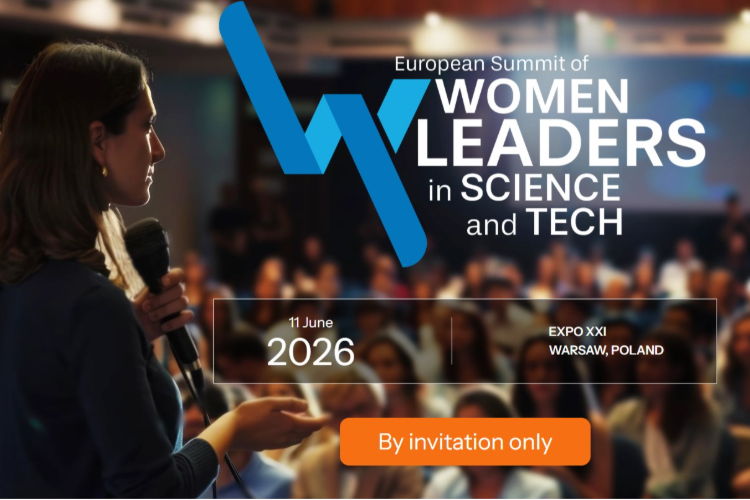
On 11 June 2026, Warsaw will once again become a meeting point for women whose decisions influence education, science, technology, diplomacy, business and public policy. The second European Summit of Women Leaders in Science and Tech will take place alongside the eighth edition of Perspektywy Women in Tech Summit, creating a high-level space for leaders who do much more than speak about change: they manage institutions, define strategies, lead universities, represent countries, steer companies, build research agendas and take responsibility for the systems in which science and technology develop.
The idea behind the Summit is ambitious and very concrete. Its first edition, held in Warsaw in 2025, was presented by the European University Association as an unprecedented gathering of CEOs, female rectors, directors of research institutions, ministers and distinguished scientists, designed to support the creation of a high-profile network of women leaders in science and technology. The 2026 edition continues this mission with even greater institutional weight.
Women from different spheres of responsibility
The Summit brings together women from different spheres of responsibility: government, academia, diplomacy, science, business and technology. This is what makes the event strategically important. The future of science and technology is shaped through education systems, research funding, university governance, international cooperation, public policy, corporate infrastructure, digital transformation and social trust.
The Summit connects women who operate at all these levels. It creates a space where policy, research, education, diplomacy and business are discussed together — because decisions made in one sector directly affect the others.
Government leaders and public policy
Among the most visible participants are representatives of the Polish government and public administration — women whose work directly affects education, higher education, culture, climate policy and digital transformation.
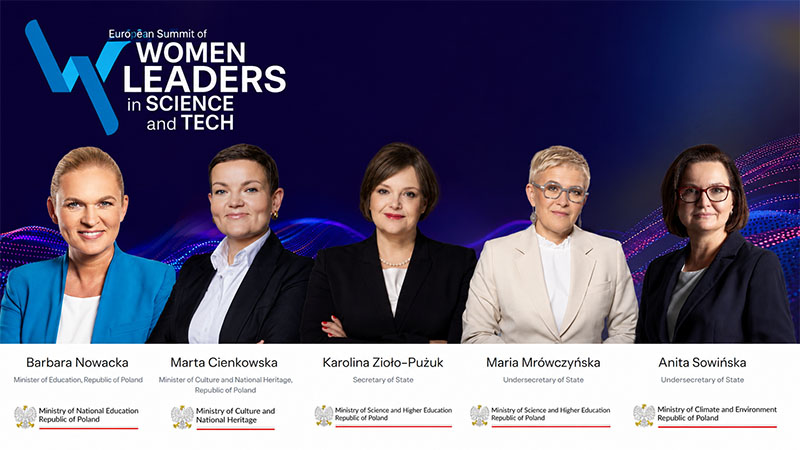
Barbara Nowacka, Minister of Education of the Republic of Poland, brings the perspective of one of the most strategic public systems: the education pipeline that determines who enters STEM, who receives early encouragement, and who sees science and technology as a possible future. Marta Cienkowska, Minister of Culture and National Heritage, adds the cultural and institutional dimension of innovation, reminding us that technology develops within society, public institutions and shared systems of meaning.
The presence of Karolina Zioło-Pużuk, Secretary of State at the Ministry of Science and Higher Education, and Maria Mrówczyńska, Undersecretary of State at the same ministry, anchors the Summit in the realities of research policy, academic development and the future of Polish higher education. Mrówczyńska’s profile is particularly relevant: she combines public responsibility with an academic background in engineering and technical sciences, linking institutional decision-making with the lived experience of science itself.
This governmental perspective is broadened by Paulina Piechna-Więckiewicz, Undersecretary of State at the Ministry of National Education, Anita Sowińska, Undersecretary of State at the Ministry of Climate and Environment, and Agnieszka Jankowska, Chairwoman of the Digitization Council. Together, they represent areas that increasingly overlap: education, climate, digital governance, science policy and technological responsibility.
Their role at the Summit is essential because the challenges discussed there require more than visibility. They require public instruments, regulation, funding, institutional trust and long-term strategy.
University leadership and the future of higher education
The academic voice is equally strong. The Summit brings together rectors and university leaders who manage institutions where scientific careers begin, research communities are built and future experts are trained.
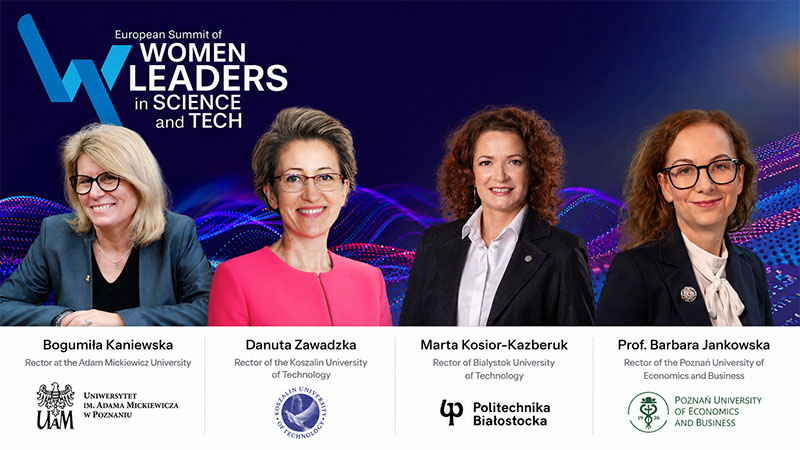
Bogumiła Kaniewska, Rector of Adam Mickiewicz University in Poznań, Danuta Zawadzka, Rector of the Koszalin University of Technology, Marta Kosior-Kazberuk, Rector of Bialystok University of Technology, and Prof. Barbara Jankowska, Rector of the Poznań University of Economics and Business, represent different parts of the higher education ecosystem - from broad research universities to technical universities and economics-oriented academic leadership.
Their presence matters because universities are among the most decisive environments for women in science and technology. They influence who gets access to laboratories, doctoral schools, mentors, grants, promotions, international networks and leadership positions. When rectors take part in this conversation, the discussion moves beyond general encouragement and enters the territory of institutional responsibility: how universities recruit, support, promote and retain women in fields where their talent is still too often underused.
The academic leadership represented at the Summit is wider than the group of rectors. Katarzyna Halicka, Vice-Rector for Education at Bialystok University of Technology, Anna Fidelus, Vice-Rector for Student Affairs and Education at Cardinal Stefan Wyszyński University in Warsaw, Agata Osińska, Pro-Rector for Education and Science at PUZ in Suwałki, Liene Briede, Vice-Rector for Innovation at Riga Technical University, Malina Kaszuba, Vice-Rector for Innovation and Cooperation at the University of Siedlce, Prof. Anna Chrobok, Vice-Rector for Student Affairs and Education at the Silesian University of Technology, Katarzyna Dziubalska-Kołaczyk, Vice-Rector for Research at Adam Mickiewicz University, Katarzyna Ożańska-Ponikwia, Vice-Rector for Student Affairs and Education at the University of Bielsko-Biała, and Katarzyna Sygit, Vice-Rector for Science at the University of Kalisz, all bring different but complementary perspectives on teaching, research, innovation, student affairs and institutional transformation.
The presence of these university leaders makes the full academic pathway visible: from recruitment and education to research leadership, innovation and institutional governance.
Diplomacy and international cooperation
The international dimension of the Summit is carried by women in diplomacy. Enass Alshahwan, Ambassador of the Kingdom of Saudi Arabia to the Republic of Poland, Oyundari Navaan-Yunden, Ambassador of Mongolia to Poland, Koviljka Špirić, Ambassador of Bosnia and Herzegovina to Poland, Sandra América Noriega Urízar de Kugler, Ambassador of the Republic of Guatemala to the Republic of Poland, and Violeta Agrici, Ambassador of the Republic of Moldova to the Republic of Poland, show that science and technology are also matters of international cooperation, strategic trust and diplomatic relations.
Their role is especially important because research partnerships, student mobility, academic exchange, digital regulation, climate technologies, data governance and technological security all depend on relationships between countries. By bringing ambassadors into the conversation, the Summit connects women’s leadership with science diplomacy - the field where knowledge, international relations and long-term development meet.
Scientists and research institution leaders
The Summit also gives strong visibility to scientists and leaders of research institutions. Agnieszka Mykowiecka, Deputy Director for Scientific Affairs at the Polish Academy of Sciences, represents one of the key institutions of Polish research. Jolanta Szempruch and Katarzyna Socha, also connected with the Polish Academy of Sciences in the Summit programme, bring expertise from the social, educational and health-related dimensions of science. Ala Saleh Alluhaidan, Professor in the Department of Information Systems at Princess Nourah Bint Abdulrahman University, adds a global academic and technological perspective.
Alongside them are women whose academic expertise spans engineering, chemistry, linguistics, medical and health sciences, public health and innovation. Maria Mrówczyńska brings engineering and technical sciences into public policy. Anna Chrobok contributes expertise in organic chemistry. Katarzyna Dziubalska-Kołaczyk represents research leadership and linguistics. Katarzyna Sygit brings the perspective of medical and health sciences.
This range is crucial. The Summit shows the full ecosystem of knowledge: technical, social, medical, linguistic, economic and organizational.
Business, technology and implementation
The business and technology sector completes the picture. Marina Dubakina, CEO & CSO of IKEA Retail Poland, Olga Surugiu, CEO of Orange, Gauri Kapur, Vice President of Corporate Applications and Enterprise Data & Analytics at Hitachi Vantara, Katarzyna Majewska, Vice President of the Management Board responsible for Operations and Technology, Marta Jakowluk, CHRO at OLX, Iwona Kozera, Managing Partner at EY Poland, Sylwia Pyśkiewicz, CEO of Equinix, Magdalena Bezulska, President of Veolia Term Group, Maia Mazurkiewicz, CEO of PZU Foundation, Anna Kieszkowska-Grudny, CEO of Bez Stresu, and Magda Groszek, Managing Director at Goldman Sachs, represent organizations where technology is deployed at scale - in infrastructure, data, operations, finance, HR, sustainability, retail, telecommunications and digital services.
Their presence is vital because science and technology gain real social and economic force only when they are implemented. Companies decide how digital systems are built, how data is used, how infrastructure is maintained, how talent is developed, how AI enters organizations, how cybersecurity is treated, and how innovation becomes part of everyday work.
The Summit therefore connects academic and public leadership with corporate execution — a connection without which even the best ideas remain theoretical.
Organizations, foundations and social impact
The programme also includes leaders of organizations and foundations who strengthen the social dimension of the event. Ewa Rumińska-Zimny, Vice President of the Management Board of Kongres Kobiet, brings an economic and gender equality perspective. Rupa Dash, connected with the World Woman Foundation, adds a global women’s leadership and mentoring context. Monika Bondarowicz, Managing Director of Fundacja Roberta Dobrzyckiego, contributes expertise in communication, strategy and social impact. Barbara Juszczyk, Managing Director, broadens the managerial and organizational layer of the Summit.
This part of the programme is important because science and technology are not only institutional or corporate matters. They affect social mobility, public participation, economic security and access to opportunity. Organizations and foundations help translate high-level conversations into broader social engagement.
A meeting across sectors
The European Summit of Women Leaders in Science and Tech is powerful because it does not gather one type of leader. It brings together women who govern, teach, research, represent, negotiate, manage, invest, build and implement.
They come from ministries, universities, embassies, research institutions, technology companies, corporations and foundations. Each group sees science and technology from a different angle. Together, they create a much fuller picture of what responsible leadership in this field now requires.
Women’s leadership in disruptive technologies
The Summit’s importance also lies in the moment in which it takes place. Disruptive technologies are no longer distant promises. Artificial intelligence, automation, data systems, cybersecurity, quantum technologies, climate technologies, health innovation and digital infrastructure are already changing institutions, labour markets, education and public life.
The Warsaw Women’s Declaration for the Future of Disruptive Technologies, formulated during the first edition of the Summit, emphasized the critical role of women in guiding these innovations toward responsible and ethical development.
The 2026 edition carries that conversation forward. It asks who has a seat at the table when major technological and scientific decisions are made. It highlights women who already sit at those tables — and women who create new ones. It shows leadership not as a symbolic presence, but as institutional authority, expert knowledge, strategic responsibility and the ability to move systems.
In Warsaw, these women will meet as ministers, rectors, ambassadors, scientists, CEOs, directors, professors and strategists. They will also meet as representatives of a broader shift: women are increasingly present in the spaces where science and technology are governed, financed, explained, implemented and internationalized.
European Summit of Women Leaders in Science and Tech is therefore more than a high-level gathering. It is a structured view of influence. It shows how many different kinds of leadership are needed to build a science and technology ecosystem that is ambitious, ethical, inclusive and effective.