
Why the future of energy and trillion-dollar businesses might not be hidden in labs, but sitting right inside the global South's landfills? What is the literal "physics of innovation" and why are true breakthroughs impossible without a culture that strips away the shame of failure? Why modern anxiety around artificial intelligence is completely justified, and why Big Tech needs to focus on its products while leaving social policy to society.
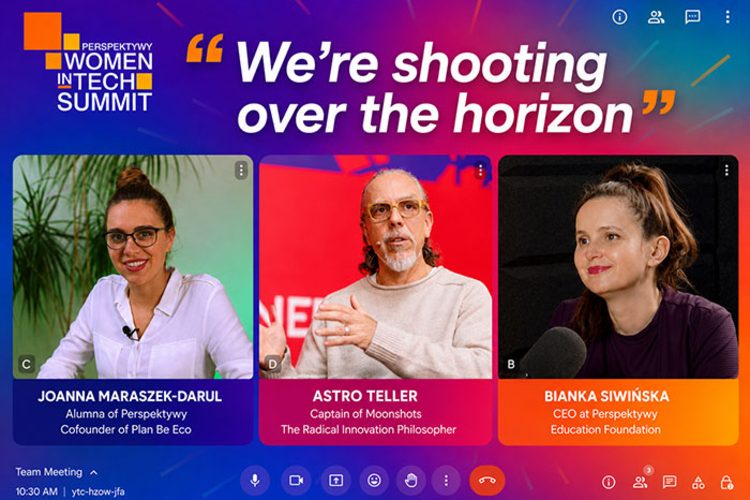
We talk about all of this with ASTRO TELLER, known as the Radical Innovation Philosopher and Captain of Moonshots. READ MORE...
He is responsible for projects that aim to solve problems on a civilizational scale, such as Waymo, Wing, and Verily - ventures that began as internal experiments and later became independent companies.
Interviewing Astro, who will be a Special Guest at the Perspektywy Women in Tech Summit 2026, are:
-
Joanna Maraszek-Darul – Alumna of Perspektywy programmes, Cofounder of Plan Be Eco.
-
Bianka Siwińska – CEO at Perspektywy Education Foundation.
Bianka: I wanted to start with a question about Europe. In Europe, for the last two years, we have been experiencing a big debate about the innovation potential of Europe as a whole concept. We are discussing the very important Draghi report. Draghi is the guy who prepared the whole report on how innovation works in Europe. And the general result was that, actually, Europe doesn't have this innovation spirit anymore, and that we are kind of blocked somehow by our regulations, by a lack of willingness to take risks, and by this split between different countries, where everything is only loosely connected. And now, we know that we are forced to build a new culture of innovation here, and that we need to be strong, we need to be sustainable, and we need to be independent in the world. So, what would you suggest to Europe and to Poland to start this new era of building innovation? What part of your experiences should we use to make this innovation spirit come alive again?
ASTRO TELLER: I can answer your question. Let me start though by saying I'm not European, so I feel like I can tell you maybe some things I would suggest, but I understand that this is a pretty complicated topic and I don't pretend that there's an easy fix to it. That said, I don't think this is the only thing, but I think in the top two or three, one of them is a fundamental misunderstanding about why I talk so much about failure.
I don't think, especially in Europe, that this is seen as a natural or even required part of the process. Failure is seen as something kind of irresponsible and sloppy, that somehow happens over in Silicon Valley, but just like, "Ugh, let's not do that." You cannot have radical innovation without mostly being wrong. There is no choice in that. That is the physics of radical innovation. It is the definition of radical innovation, that most people's first principles thinking just doesn't lead you to the solution. If it did, it wouldn't be radical innovation.
So, it is absolutely table stakes. It's maybe not a sufficient condition, but it is a necessary condition to have a culture in which people trying something and not getting a win cannot be a career-limiting move for them.
And I don't know, you know better than me, but I think that Europe by and large has maybe not a great venture capital system, but has lots of money. It has great engineering talent, design talent, product talent. That's not the problem. Getting more money into the venture system would be better, but I actually think that's a secondary problem. If the culture appreciated that you have to try things and learn from them, and you learn by being wrong, accepting that you're wrong, processing why you were wrong, and then moving on quickly and without a lot of shame or guilt... that is like the tightest part of the learning loop and the process of innovation. So, I guess if I ran Europe for a day, that's what I would spend my energy on.
Bianka: Yes, Europe is not so easy to be run, actually, because it's like a very complicated entity.
ASTRO TELLER: That's why I said at the beginning, I understand it's not as easy as it sounds.
Joanna: I would love to start with the current projects, which I'm absolutely amazed by. And the first one, the Waymo, because right now, I would say that this is the most recognizable project all around the world. But when I read about it, I had the feeling that Waymo has been ready for like a decade. And what does this timeline teach us about patience in innovation? How do you feel about that? Whether you were patient enough, or whether this project happened out of nowhere? So, I would love to push the idea of patience in innovation and pursuing for the goal.
ASTRO TELLER: I'll speak to Waymo, but Google Brain, which also came from X, actually graduated from X several years before Waymo graduated from X. And it is now, you know, certainly from a certain perspective, much better known even than Waymo is. The modern explosion of machine learning, not entirely, but in no small part came from Google Brain. But that took 15 years.
Waymo, we understood even 15 years ago that it was going to be possible. Exactly how long it would take, exactly how much money it would take, that was less clear. But radical innovation takes time. Like, very roughly, a decade from crazy idea to not crazy idea, and then sometimes as much as another decade from not crazy idea to a profitable, enduring business. It doesn't always take that long, but like the reality is you can't compress that time all that much, and most people don't have the stomach for 20 years of waiting.
But just like, you know, there's realities. Like, even if self-driving cars were perfect, they wouldn't be everywhere next year because people have already spent a lot of money on the cars that are on the road. It's a sunk cost, and people are going to want to get their value for the money that they've spent. So, it's going to take a while, and innovation always does. I don't know if that gets at what you're asking, but we always have said this takes a while.
And so, there wasn't a, you know, "it sucked, it sucked, it sucked, overnight success." That's actually not what happens. Most of these things usually are exponentials of various kinds. But it's the nature of an exponential curve, because people don't think in exponential terms, that they see the beginning part of the exponential as essentially flat. Because there's some functional floor below which it just doesn't sort of get into people's consciousness, so it feels like it's zero. Waymo's progress felt like it was zero for a decade. It wasn't zero, it's just no one was paying attention to that exponential. And then all of a sudden, once it got past a certain threshold, people started paying a lot of attention. And that's what often causes innovation to feel like it just happened.
I'll give you an example. How much are you following Wing, the drones for package delivery? A lot less? I guarantee you, one to two years from now, it will feel like they were an overnight sensation. But they weren't. They've been on a curve that's only two, two and a half years less long than Waymo. But they're ramping very quickly, it's absolutely going to change the world, and all of a sudden people are going to be like, "Oh, where did that come from?"
Joanna: Yeah, so I can see how excited you are about those drones delivery. And this is why I must ask you whether there is any moonshot that you have the greatest hope with and the biggest excitement with? And if it is the same project, or the hope and excitement comes to different ones?
ASTRO TELLER: I'm excited about all of them. It's a little bit like asking me to pick between my children. But let me tell you a very brief story that tickles me a little extra. So, we have a project, which is public, at X right now. It's much earlier. Waymo is 16 years old now; this project I'm about to tell you about, Materra, is 4 and a half years old. So, much earlier in its process, many, many fewer people.
But right now, depending on how you count a little bit, somewhere between 1 and 3 trillion dollars a year goes to landfill around the world, not because we couldn't recover that value – the value is embodied in these things, rare earth minerals, rocks shaped a certain way inside the concrete, long-chain polymers that make up the plastics of the world – it's because we don't know exactly what we're looking at as it goes across conveyor belts around the world. So, we just send it to landfill.
If you had mass spectrometry and you could look down on this, vaporize a little bit of it, and see what molecules, what elements are actually in this thing, you could know how to recycle it, whether it was worth recycling, and you could recover 1, 2, 3 trillion dollars a year, and do a phenomenal goodness for the world because the world would become much more circular and we would have to dig up the earth a lot less.
Materra has built kind of a poor man's mass spectrometry so that we can see every molecule that's in this potato chip bag as it zooms across the conveyor belt. And, am I excited that that will be really good for the world by making the world more circular? Yes. Am I excited that that's likely to be a very large and profitable business? Yes.
The thing that tickles me the most about it is that, very roughly, the global North has been dumping our garbage on the global South for at least half a century. And if it turned out that the oil wells of the future were in fact the landfills that we've been filling up in the global South, it would be one of the few times in history that colonialism ran in reverse. We accidentally sent all this value to them instead of taking value from them. And that just would make me so off-the-charts happy. That's an example of one that gets me a little extra excited.
Joanna: This is absolutely crazy idea, but I must say I really relate to that. And thanks for bringing back the circularity and the geopolitics, because this is all connected with the oil. And I must say, I'm watching the current situation, and the war has done more to the energy transformation than the climate advocacy for decades, yeah? And how do you feel about that, about this geopolitics shift while thinking about fossil fuels? And does that shift have any impact on the Moonshot Factory agenda for electricity transmission, or you stay to the roots because there were some very good projects in the Moonshot Factory about energy?
ASTRO TELLER: Yeah, let me come back to the "decade to get from crazy idea to not crazy idea, and then another decade from not crazy idea to a profitable and enduring business." We cannot change our strategy every time a war starts or ends. Like, that just doesn't work, because we're shooting over the horizon. So, we have to not be rattled by these short-term changes.
Are we interested in how to help the grid work better? For sure. Our moonshot Tapestry is actually already helping around the world, and we're really proud of them. But we started that 8 years ago when no one was talking about the grid. The grid had been going sideways for two decades in terms of electricity usage. All of a sudden it matters now, and it looks a little bit like we saw this coming. Maybe a little bit, but actually the truth is closer to: we're trying 100 to 200 things every year, and then we kill them off based on evidence. That's how the Moonshot Factory works. And the ones that survive, that turn out to be less crazy than we thought, more valuable to the world than we thought, are the ones that survive this pressure-testing process.
So, yes, we're going to stick with that process and trust that in the end, if we make a Google Brain, or a Waymo, or a Wing, or a Tapestry a few times a decade, we're doing our job, and we're helping the world, and we're helping Alphabet. I can feel pretty good about that.
Bianka: Why did you decide to come to Poland, and especially for a big women event, Women in Technology and Science event? And the second question, and the last one, will be about... I'm sorry, but I need to ask it... what do you think about the development of artificial intelligence in next years?
ASTRO TELLER: So, the first one is: I'm interested in going to places where people still have some positivity, excitement about the world. I believe really deeply that if we're going to find unusual new perspectives to help the world, we need to have people at X, and partnered with X, who see the world differently from the way that we do. That certainly isn't just women, but I think that women, and women engineers in particular, are one of the most underused resources in the world, sadly. So, I would love to find ways for us to work more with Poland, with women engineers around the world. We're hiring, so that seems pretty natural and easy to me as a reason to show up. And I happen to be in Europe for multiple things, including Hello Tomorrow, at the same time.
On the second one, artificial intelligence is going to make the world very different. And I understand that people have anxiety, even fear, because change is scary for a lot of people. I accept that. And they're not wrong because historically, when the world has changed a lot, it has tended to get better in the medium to long term, but there have often been real pain for at least parts of societies in the interim. And I think we as a species, we as civilizations, could be doing a much better job of helping the people in our society through these periods of high change.
So, I see this as an opportunity for us. Technology has tended to make the world better. You wouldn't go back to a time without the internet, you wouldn't go back to a time without the printing press, you wouldn't undo penicillin, or the germ theory of disease, or fire, or the wheel, or electricity, or computers. We're also going to see artificial intelligence that way, I'm exceptionally sure about that.
And that does not mean that it won't be a bumpy ride on the way to us feeling altogether, and sort of in uniform... 95% of the world would agree that electricity has been good for humanity. We will get there with artificial intelligence, but how we help society through that process, that I'm worried about too.
But I think that talking about the new technology misses the point. If it wasn't artificial intelligence, it would be something else. The real underlying problem is that technology tends to have diffuse benefits and concentrated harm. When you make something cheaper overseas, everyone in your country gets to buy that cheaper thing – they all get that benefit. But the few people who worked on making that thing in your country lost their jobs. That would be fine, it's still a net positive for Poland, but what are we doing for those people who lost their jobs? That's the question we should be asking, not being angry because your flat-screen television is cheaper. So, I just... I'm not really changing the subject, but I think that that's actually the underlying point. We're going to have to change and adapt as a species, as we have had to do before in the presence of things like electricity. And how we respond is what's going to matter, not the details of how it evolves. That's my belief.
Bianca: So you think that Big Tech should be also co-responsible for solving the social problem around artificial intelligence?
ASTRO TELLER: Absolutely not. I think Big Tech, any company, should feel responsibility for making good products and thinking deeply about the unintended consequences of its products. Yes. Surely you do not want any large company, Big Tech or otherwise, to come and tell Poland how to run its society, right? You should want Poland to decide how to run Poland, surely. No, that does not absolve any company of the responsibility of making good products, but I don't think you want any large company making social decisions about your country, do you?
Bianka: No, no, definitely no. I didn't think so.
Gość: I didn't think so.
Bianka: Okay, thank you so much, and thank you for your time and thank you for this opportunity, and we will see us soon in Warsaw.
Joanna: I hope we'll amaze you with Polish innovation. See you in Warsaw!
ASTRO TELLER: See you soon!